
Quick Summary
Proper F87 M2 fitment begins with factory wheel and tire specifications, followed by a careful review of the exact model, brake package, suspension, and driving purpose. Wheel width, offset, tire construction, and alignment all influence clearance and road behavior. Professional fitment checks help preserve the balanced steering response, traction, comfort, and composed character expected from the M2.
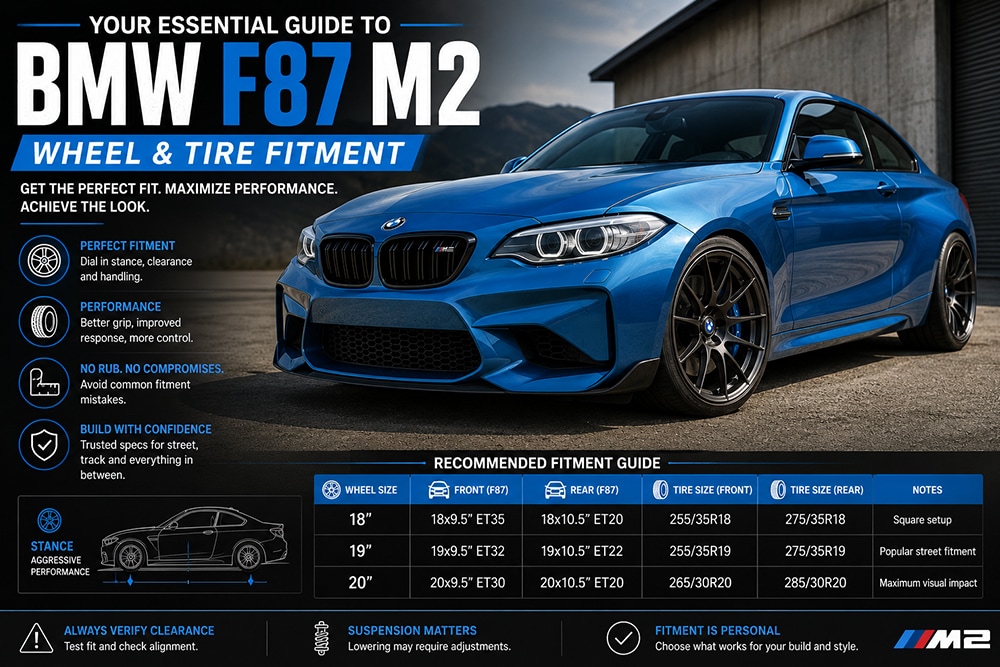
The BMW F87 M2 was engineered with compact proportions, a wide stance, and chassis tuning that rewards precise wheel and tire choices. Selecting BMW M2 wheels requires more than matching diameter and bolt pattern, since brake clearance, offset, tire width, suspension geometry, and intended use all shape the result. A setup that looks striking can compromise steering feel, ride comfort, or clearance when its dimensions are poorly matched.
The right combination preserves the car’s character while giving you the response and confidence you expect. Let’s begin with the factory foundation.
Start With the Factory F87 M2 Wheel and Tire Specifications
Every F87 M2 fitment decision should begin with the factory setup. BMW equipped the car with 19 inch wheels measuring 9 inches wide at the front and 10 inches wide at the rear, paired with ET29 and ET40 offsets. Standard tire sizes are 245/35R19 in front and 265/35R19 at the rear. The platform also uses a 5 by 120 bolt pattern, a 72.6 millimeter center bore, and M14 by 1.25 wheel hardware. These dimensions establish the balance BMW intended between steering response, rear traction, brake clearance, and ride quality. Staying close to them usually creates a composed result with fewer clearance concerns for drivers and less influence on electronic systems.
Identify Your F87 M2 Model Before Choosing Wheels
Before selecting wheels, confirm which F87 M2 sits in your garage. The original M2, M2 Competition, and M2 CS share similar proportions, yet their brake packages differ in ways that affect fitment. The Competition uses larger front brakes than the earlier model, while the CS may carry similarly demanding hardware. An 18 inch wheel that clears the original M2 may contact the caliper on another version, even when width and offset appear suitable. Spoke shape and barrel design also influence available space. Treat every advertised size as a starting point, then verify compatibility with the exact brake package installed from the factory on your car.
Compare OEM Style, Square, and Staggered Fitment
An OEM style setup stays close to the factory wheel widths, offsets, and tire sizes, making it the most straightforward choice for balanced road use. A square arrangement uses matching wheels and tires at all four corners, which permits front to rear rotation and can create a more neutral cornering response. A staggered layout keeps wider tires at the rear, supporting traction during acceleration and preserving the character BMW built into the chassis. Each approach changes steering feel, tire wear, and available grip. Your best choice depends on how you drive, how often you rotate tires, and how closely you want the car to retain its original behavior. Road conditions should guide the final decision.
Understand Wheel Width, Offset, and Brake Clearance
Wheel width and offset determine where each wheel sits in relation to the suspension and body. A lower offset generally moves the wheel outward, while a higher offset places more of it toward the strut and inner suspension components. Clearance must be checked at the fender, spring perch, control arms, caliper face, and wheel barrel. Diameter alone cannot confirm brake clearance, since spoke contour and internal barrel shape may still create contact. Tire construction adds another variable, as two tires carrying the same printed size can have different shoulder profiles. A proper fitment review considers every dimension together rather than relying on one number throughout the full range of motion.
Match Tire Size to Street, Track, or Winter Driving
The right tire size should reflect how and where you drive. A street focused setup usually favors predictable steering, useful sidewall compliance, and dependable clearance during daily use. Track oriented drivers may prefer wider tires and a more aggressive alignment, although those choices can reduce comfort and increase wear. Winter driving in Northeast Ohio calls for a setup that supports cold temperature grip and snow traction, with suitable brake clearance on the exact M2 variant. Tire compound is as important as size, since construction and tread design shape real world performance. Choose the package around your environment and conditions throughout the year, not appearance alone.
Consider Suspension, Camber, and Ride Height Changes
Suspension changes can alter fitment even when the wheel specifications remain unchanged. Lowering springs reduce available travel, while some coilovers position the spring perch closer to the inner tire. Camber plates can create additional outer clearance, yet aggressive settings may increase tire wear during regular road use. Spacers move the wheel outward and can solve one clearance issue while creating another at the fender. Ride height, alignment, spring shape, and installed hardware should all be measured before a wider setup is selected. Professional assessment is the safest route when the car has been modified from its original chassis configuration and regularly used on public roads.
Check Load Ratings, TPMS, and Installation Details
Final fitment depends on more than wheel diameter and tire width. Replacement tires should carry suitable load indexes and speed ratings for the vehicle, while every wheel should use compatible hardware and correctly matched tire pressure sensors. Tire pressure must follow the vehicle label and should be checked when the tires are cold. After installation, clearance should be evaluated at full steering lock and throughout suspension movement. Alignment may also need attention, especially after changes to wheel width, offset, ride height, or camber. These finishing details protect steering consistency, tire life, braking behavior, and the composed road feel expected from an F87 M2 over time.
Choose Your F87 M2 Fitment with Confidence
The right F87 M2 fitment should feel intentional from the first turn of the wheel. A matched setup preserves the car’s balance, protects clearance around the brakes and suspension, and supports the way you drive. Factory dimensions remain the safest reference, while wider, square, staggered, winter, or track focused choices require closer evaluation. The best result is one that looks purposeful, responds naturally, and remains comfortable on roads.
At BMW Cleveland, our parts and service teams can help you select compatible wheels, tires, BMW parts, and TPMS components for your exact M2 variant. Our BMW trained technicians can inspect brake clearance, suspension changes, alignment needs, and installation details before your new setup goes into service. We can also assist with tire installation, balancing, alignment, seasonal tire planning, and ongoing maintenance, giving your M2 attentive support through every stage of ownership.
Contact BMW Cleveland to plan a wheel and tire setup tailored to your F87 M2.
FAQs
What wheel sizes fit the BMW F87 M2?
Factory specifications offer the most reliable starting point, yet the correct fit also depends on your exact F87 variant, brake package, suspension, tire construction, and intended use. The original M2, M2 Competition, and M2 CS can have different brake clearance needs, so wheel diameter and offset alone cannot confirm complete compatibility.
Is a square or staggered setup better for BMW M2 wheels?
A square setup uses matching wheel and tire sizes at all four corners, which allows front to rear rotation and can create a more neutral feel. A staggered setup keeps wider tires at the rear, supporting acceleration traction and preserving the handling character BMW designed into the F87 M2. The better choice depends on your driving priorities.
Can 18 inch wheels fit an F87 M2?
Some 18 inch wheels fit the original F87 M2, but larger brake packages on the M2 Competition and certain M2 CS configurations may require 19 inch wheels. Spoke contour, barrel shape, suspension components, and installed tire width also affect clearance. The exact wheel design should receive professional fitment verification before installation.