
Quick Summary
The F87 combines compact proportions with rear wheel drive, strong inline six engines, and chassis components related to the contemporary M3 and M4. Its progression from the 365 horsepower original M2 to the 405 horsepower Competition and 444 horsepower CS added greater speed, cooling capacity, and structural focus. A manual transmission remained available throughout the range, while four seats and a useful trunk supported regular driving. Its lasting appeal comes from the cohesion between size, response, power, and usability.
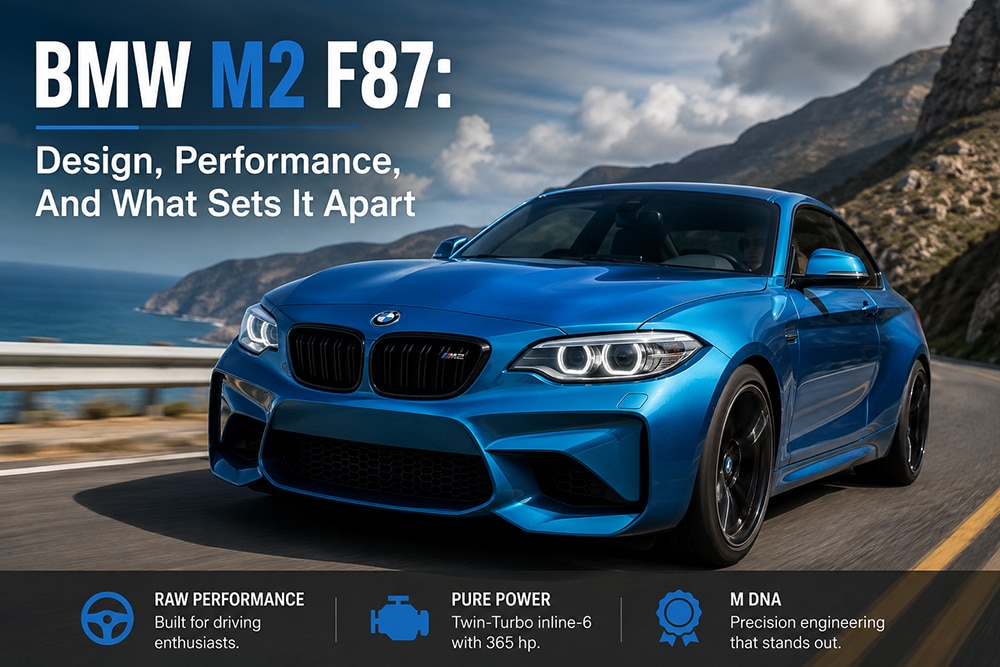
Few modern performance coupes have earned such lasting admiration as the BMW M2 F87. Introduced as the first generation of the M2, it brought compact proportions, rear wheel drive, and straight six power into a form that felt purposeful from every angle. Its stance, controls, and engineering reflected BMW M’s long tradition of building cars around the driver. Even years after production ended, the F87 continues to attract enthusiasts who value precision, balance, and character.
Here is where its enduring appeal begins to take shape.
The Origins of the BMW M2 F87
Arriving for the 2016 model year, the first generation M2 carried the internal F87 chassis code and revived BMW M’s compact coupe tradition. Its lineage reached back to the 2002 turbo, E30 M3, and 1 Series M Coupe, yet its engineering was modern. The car measured 176.2 inches long, 73 inches wide, and 55.5 inches tall, with a 106 inch wheelbase. Those dimensions placed it below the contemporary M3 and M4 while retaining four seats and a 13.8 cubic foot trunk. BMW M also widened the body and tracks beyond the standard 2 Series. That combination gave the car an identity rooted in compact scale, serious hardware, and everyday usability.
A Compact Design with a Purposeful Stance
Viewed in profile, the car combines a long hood, short overhangs, and a cabin positioned toward the rear axle. Its widened front and rear arches accommodate staggered 19 inch wheels and contribute to a broad, planted stance. Large front air openings direct cooling flow toward the engine and brakes, while the side gills recall earlier BMW competition cars. At the rear, a sculpted diffuser and four exhaust outlets make the performance intent clear. The body measures 73 inches across, giving it more visual width than a regular 2 Series. Every surface appears tightly controlled, so the design communicates strength through proportion and function rather than decoration or excessive visual detail.
Inside the Driver Focused Cabin
From the driver’s seat, the layout feels compact, clear, and deliberately arranged around immediate control. The original model features an M steering wheel, sport seats, Alcantara trim, blue stitching, and open pore carbon fiber surfaces. Physical switches keep climate, audio, and driving functions within easy reach. Four seating positions and a 13.8 cubic foot trunk preserve everyday usefulness. Competition models introduced M Sport seats with integrated head restraints and illuminated M2 emblems. The CS moved further with a carbon fiber center console, Alcantara details, and lighter M seats. Across every version, visibility, supportive seating, and controls create a cabin that feels purposeful without sacrificing comfort.
Turbocharged Inline Six Performance
Under the hood, the original model uses a turbocharged 3.0 liter N55 inline six producing 365 horsepower and 343 pound feet of torque. An overboost function briefly raises torque to 369 pound feet, helping the car accelerate from 0 to 60 mph in 4.3 seconds with the manual. The seven speed M Double Clutch Transmission lowers that time to 4.1 seconds. Top speed is electronically limited to 155 mph, or 168 mph with the M Driver’s Package. Power reaches the rear wheels through either a six speed manual or the dual clutch gearbox. Strong low speed response and smooth upper range delivery define its character.
Chassis Engineering Beyond the Standard 2 Series
Beneath the body, BMW M fitted aluminum front and rear axle components related to those used by the contemporary M3 and M4. M Compound brakes, M Servotronic steering, staggered tires, and an electronically controlled Active M Differential complete the hardware. The differential varies locking action across the rear axle to improve traction under acceleration and stability through corners. Manual transmission cars weigh about 3,450 pounds, while M DCT versions weigh roughly 3,505 pounds. A sport stability setting allows greater wheel slip before electronic intervention. A wider track and tuned suspension sharpen response without making the car feel nervous. The result is a chassis that rewards accuracy, confidence, and measured input.
M2, M2 Competition, and M2 CS Compared
Across its run, three versions defined the range. The original M2 used the 365 horsepower N55 engine, while the 2019 M2 Competition adopted a twin turbocharged S55 inline six with 405 horsepower and 406 pound feet of torque. Its 0 to 60 mph time dropped to 4.0 seconds with M DCT and 4.2 seconds with the manual. The 2020 M2 CS raised output to 444 horsepower while retaining 406 pound feet. With M DCT, it reached 60 mph in 3.8 seconds. Carbon fiber roof, hood, splitter, spoiler, diffuser, and mirror caps reduced weight and lowered the center of gravity. Adaptive M suspension completed the specification.
What Sets the BMW M2 F87 Apart
Few performance coupes combine compact dimensions, M hardware, and daily practicality with remarkable cohesion. A 106 inch wheelbase keeps the car agile, while rear wheel drive preserves clear balance under acceleration. Buyers could select a six speed manual across the range, including the 444 horsepower CS. Four seats, a useful trunk, and manageable dimensions make regular driving realistic. At the same time, M brakes, an Active M Differential, wide tracks, and strong inline six engines give the car genuine capability. Its appeal comes from how these elements interact rather than from one specification. That unity of size, response, speed, and usability gives the F87 a lasting reputation among driving enthusiasts.
Find Your Place Behind the Wheel
Compact proportions and M engineering give the F87 a character that feels immediate years after production ended. Its straight six power, rear wheel drive layout, available manual transmission, and tuned chassis create a connection that depends on balance rather than spectacle. The car remains compelling since its performance is supported by usable space, clear controls, and dimensions that suit real roads as confidently as demanding ones.
At BMW Cleveland, we can help you explore available pre owned BMW models with guidance shaped around your driving preferences, budget, and intended use. Our Client Advisors can discuss model history, equipment, ownership considerations, and inventory without adding pressure to the experience. We also support your BMW through trained service technicians, original BMW parts, diagnostics, maintenance, and repair work designed around the vehicle’s engineering.
Explore our current inventory or schedule a visit to experience the Davis Difference. Speak with our team and find the BMW that best suits you.
FAQs
What model years are included in the BMW M2 F87 generation?
The F87 generation covers the original M2 introduced for the 2016 model year, followed by the M2 Competition for 2019 and the limited production M2 CS for 2020. Each version kept the compact coupe format, rear wheel drive, and an available six speed manual, while output, cooling, structural support, and chassis tuning became progressively more focused.
How do the engines differ across the F87 M2 range?
The original M2 uses a turbocharged 3.0 liter N55 inline six with 365 horsepower. The M2 Competition moved to the twin turbocharged S55 engine with 405 horsepower, while the M2 CS raised output to 444 horsepower. The later versions also added stronger cooling, revised chassis calibration, and further weight saving measures.
What makes the F87 M2 distinctive among performance coupes?
Its appeal comes from the way compact dimensions, rear wheel drive, inline six power, and precise chassis hardware work together. A 106 inch wheelbase keeps the car agile, while four seats and a useful trunk support regular use. Manual transmission availability across the range adds another layer of driver involvement that remains highly valued.